Changbai Mountain
Demi-Gods and Semi-DevilsChangbai Mountain is both a refuge and a frontier in Xiao Feng’s northern life: its hunting grounds give him the means to care for A'Zi, while the surrounding Jurchen and Khitan worlds bring him into a conflict that unsettles any simple division between his peoples. The mountain’s wilderness offers temporary distance from the martial world, but it cannot insulate its inhabitants from the consequences of war.
Setting and life in the mountains
Xiao Feng lives among the Jurchen with A'Zi, who is recovering from the injuries he sustained while treating her. As her strength gradually returns, she grows restless from remaining in their tent and asks him to take her riding. They travel together on horseback, with A'Zi leaning against him, and spend months roaming the area except during blizzards. When the nearby country begins to feel familiar, they camp farther from the tribe for several days at a time.
The mountain’s animals and plants are part of this life. Xiao Feng hunts tigers and bears and digs for ginseng, traveling east or north when he needs to find the roots. The animals also bear the cost of A'Zi’s earlier attack on him: Xiao Feng kills many bears and tigers with his palms while obtaining what is needed to treat her. The mountain thus serves as a place of care and recovery, but that care is materially bound to hunting.
Jurchen and Khitan on the frontier
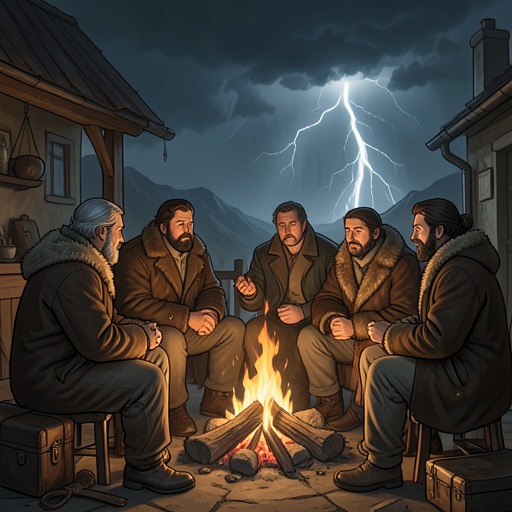
The Jurchen community around Changbai Mountain receives Xiao Feng as an honoured guest, although he is Khitan and the Jurchen are at war with the Khitans. A Han-speaking salesman, Xu Zhuocheng, acts as interpreter and explains the situation: the man at the centre of the gathering is the Jurchen chief HeLiBu, whose second son is AguDa. Because AguDa praises Xiao Feng and the Jurchen admire capable heroes, they do not hold his Khitan identity against him.
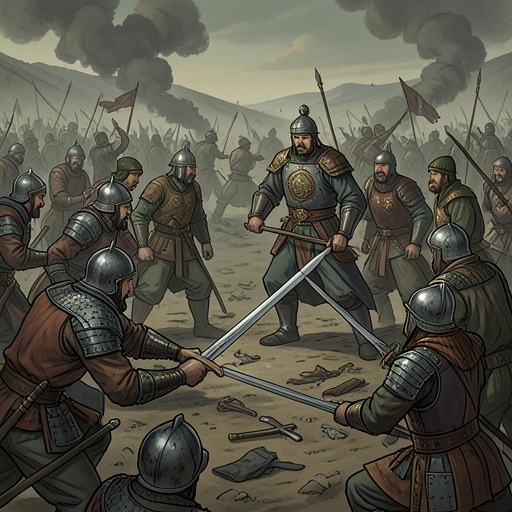
That welcome does not prevent violence between the neighbouring peoples. During a hunt, a Khitan force pursuing a bear comes upon AguDa and the Jurchen hunters. The Khitans shoot without first establishing who is present, and an elderly Jurchen hunter is killed. AguDa rallies his people as the fighting escalates; although Xiao Feng feels a bond with the Khitans as his own people, he intervenes to protect the Jurchen. He disarms and throws two Khitan riders without killing them, then fires arrows that knock four more from their horses while sparing their lives. The encounter makes the border’s divided loyalties immediate: Xiao Feng belongs by ancestry to one side, yet acts to prevent the other from being overwhelmed.
A landscape beyond the raiding cycle
The wider frontier economy gives the mountain’s relative refuge a sharper meaning. The Liao army takes supplies by raiding neighbouring lands, a practice called “Beating The Grass Valley”; Song forces retaliate with raids of their own, called “Beating The Standing Valley.” The novel describes civilians near the borders as living under continual threat of capture. When Xiao Feng later encounters Song captives taken by Liao troops, he recognizes the same suffering across the division that had troubled him during the Jurchen-Khitan clash.
His response is shaped by the years he has spent away from the martial world among the Jurchen. Seeing the captives, Xiao Feng reflects on shared language and food and asks why people insist on separating Khitan, Song, Jurchen, and Korean communities when each side answers raiding with further violence. He releases the captives and urges them to move away from the border, acknowledging that he may not be able to save them again. Changbai Mountain’s significance lies in this contrast: it shelters a fragile, everyday coexistence, even as the frontier around it repeatedly turns ethnic identity into a reason for attack.